
The India that needs strategic alliances, defence cooperation and engaging meaningfully with neighbouring countries is quietly moving ahead with confidence, says Tarun Vijay

'Clarifying that modernisation of national defence and armed forces should be completed by 2035, Xi Jinping asserted the goal is to make the People's Liberation Army a "world class force" that "can fight and win" by 2050,' points out former RAW officer Jayadeva Ranade.

Chinese President Xi Jinping has suggested five thrust areas to improve relations with India. It is likely all these issues, in addition to the points raised by Xi at Fortaleza, will be part of the joint declaration at the end of his visit to India, says Srikanth Kondapalli.

'Intrusions by PLA troops in the Ladakh sector are more in number than elsewhere and this region is now likely to remain an area of enhanced Chinese interest,' warns China expert Jayadeva Ranade.
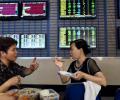
China's domestic debt is a major concern.

The world economy's growth engine is slowing, but not collapsing.

The Chinese Communist Party's all important 19th Party Congress is just months away, and President Xi Jinping finds himself confronting unlikely challenges to his pre-eminent position, says former RA&W officer and China watcher Jayadeva Ranade.

Srikanth Kondapalli on what to expect from the seventh BRICS summit meeting to be held in Russia in July.

Prime Minister Malcolm Turnbull's first State visit to India is an indication of the success of India's Act East Policy, says Dr Rahul Mishra.

'The accusation that Pakistan risks losing sovereignty to China is emotive and has the potential to spread.' 'China will, however, remain intent on achieving its strategic ambitions of acquiring Gwadar port and securing a large chunk of Pakistan occupied Kashmir,' says former RA&W officer Jayadeva Ranade.

It was clear in Brunei at the 8th East Asia Summit that China doesn't want the South China Sea issue to even dominate the discussion, reports Sheela Bhatt, who is part of the prime minister's media contingent to the summit

Modi, who is undertaking his first visit to China as prime minister, will reach the ancient city of Xi'an, the home town of President Xi Jinping, for a summit meeting, an unusual departure from normal protocol and seen as a reciprocal gesture by the Chinese leader who was hosted by Modi in Ahmedabad when he visited India in September last year.
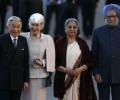
In recent years India-Japan relations have acquired rich economic content and strategic intents. Although the bilateral trade at $18 billion between the two countries is not very impressive and leaves much to be desired, the economic engagement between the two countries is both qualitatively and quantitatively noteworthy. India-Japan defence cooperation, however, has generated a lot interest among the strategic community in the context of rise of China. There has been a lot of speculation about India-Japan strategic partnership to hedge China, says Rup Narayan Das.

Considering Modi's style of practicing diplomacy, it is likely that a clear message would be conveyed to China that it is high time Beijing stops using its good relations with Pakistan as a pressure tactic against India. This is imperative not only for strengthening India-China relations at the bilateral level but also for maintaining stability at the regional level, says Sana Hashmi.

'China might soon have to seriously consider whether it prefers an Indo-US hyphenation to a Sino-Indian one.'
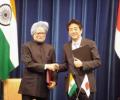
India's commitment to an open and plural security architecture attests to the fact that Asia's transition is a dynamic of both power & identity, says Zorawar Daulet Singh

Modi's arrival has changed the optics of the visit. There is a different demonstration of the confidence level in the Indian leadership, but not much has changed beyond that, reports Sheela Bhatt/Rediff.com.

The chaos on its stock markets, a fierce battle between the old and new guard in the Communist Party and the restive border provinces of Tibet and Xinjiang forebode tough times ahead for China, says Claude Arpi.

Despite vast differences in the way the media operates in the two countries, an India-China media forum will go a long way in improving understanding between the two countries, says Srikanth Kondapalli.

As Chinese army incursions continue to recur, India has cautioned China that any disturbance of peace and tranquility in the border areas can vitiate the overall atmosphere of bilateral ties.

General Zhao Zongqi is well known in India for having commanded the Chinese troops during the Dokalam episode. Zhao knows every inch and corner of the Indian border, at least the Eastern and Central sectors, including the Naku La area which witnessed fist-fights between Indian and Chinese troops in April/May. Claude Arpi introduces us to the PLA generals masterminding the Chinese aggression in Ladakh.

'It was China's rise that caused the New Cold War in Asia as it prompted the United States to rebalance its forces in Asia to experiment with engagement and containment at the same time,' says T P Sreenivasan.

The BDCA is yet another dose of insidious placebos administered on the people of India by their own government that has been in perpetual denial over the steady incremental loss of strategic Indian territory, says R N Ravi


The developments in Af-Pak region, particularly the fall out of Pak political paralysis, would make President Xi Jinping's task a little more complicated, says Colonel R Hariharan.

From early indications, the Modi government's foreign policy seems to be pragmatic and reciprocal, says K G Suresh.

A list of all the foreign visits taken up by PM Narendra Modi this year and their outcomes.

While China is bigger and feels mightier at the moment, Beijing's rulers would be well advised not to be tempted to provoke India, for that would only trigger a chain reaction around the world that would not serve anyone's interests, says Sanjaya Baru.
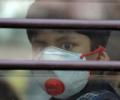
Here's what the national capital needs to do to ensure the residents stop breathing toxic fumes.

'Modi's promise of change during the election campaign was on the domestic front, but his first year in office focused on foreign policy beyond all expectations,' says Ambassador T P Sreenivasan.
'Crafting a coherent, transparent and consistent policy vis-a-vis our neighbours, leave alone the rest of the world, is unlikely to be high on the priority list of the new Indian government, which will be sworn in before June,' says Ramananda Sengupta.

What was the need for Xi Jinping, general secretary of the Chinese Communist Party, President of the People's Republic of China and Chairman, Central Military Commission, to don the new role of Commander in-Chief? Does this mean that the most powerful Chinese leader since Mao faces numerous threats from within the Communist Party?

'The intrusion in Chumar, during and beyond the Chinese president's visit, is unprecedented and has qualitatively changed the tone of the India-China relationship,' says Jayadeva Ranade, a member of the National Security Advisory Board.

'Chinese leaders rarely receive their foreign guests in cities other than Beijing. Such respect for India!' 'Does it mean that Modi could replicate "the warmth and unconventional way" by sending Indian troops into Tibet, as Xi did in Chumur (Ladakh) when he arrived in India? Of course, Indians are far too polite to do so,' says Claude Arpi.

The administration and America Inc have invested in Narendra Modi's power to transform India. Aziz Haniffa/Rediff.com reports from Washington, DC.
